Written by John Wellington | Last checked:
18+ only. Gambling can be addictive. If gambling is causing you problems, call the National Gambling Helpline free on 0808 8020 133.
Disclosure: This page does not contain affiliate links. This article was drafted with the help of AI and checked by our editor against official sources.
Search for crypto casinos in the UK and you’ll find long lists of bitcoin casinos that “accept UK players”. Very few of those lists tell you whether the sites are allowed to serve you. Fewer still explain what happens if a site keeps your money.
This matters because crypto casinos aimed at British players are almost always run without a UK Gambling Commission licence. If something goes wrong, you have no independent complaints service, no GAMSTOP protection and, often, no way to get your funds back.
What you’ll learn
- what the Gambling Commission says about crypto payments in November 2026
- why most crypto casinos marketed to UK players are unlicensed
- the main risks, including tax on crypto you spend
- legal ways to get the fast payments many crypto users want
We don’t name or link to any unlicensed crypto casino. By the end, you should be able to judge any “UK crypto casino” claim for yourself. Start with the short answer below.
⚡ Want fast, safe payouts instead?
Most people look at crypto casinos for speed. These three UK-licensed casinos publish some of the fastest withdrawal times in our November 2026 research, paid in pounds, with UK dispute services and GAMSTOP behind them. UK law requires an ID check before your first deposit, so the main check happens up front rather than when you cash out. Facts are from each casino’s own pages, checked on 12 November 2026.
1. MrQ – best for the fastest published payout promise
A published “withdrawals processed within 60 seconds or get £10” guarantee (one £10 credit per player per day). No withdrawal fees. Pay by debit card, PayPal, Apple Pay, Google Pay or Pay by Bank. New players get 100 free spins for a £10 first deposit, with no wagering (the spins expire after 48 hours).
2. Kwiff – best for fast payouts plus a big game range
“Most withdrawals are processed in under 30 minutes”, or up to 24 hours if security checks apply. No standard withdrawal fee. Pay by debit card or Pay by Bank. Welcome offer: 200 free spins on Book of Dead when you stake £20 on slots within 5 days of your first deposit, no wagering on winnings (winnings capped at £250).
3. Sky Vegas – best for instant bank payouts
Withdrawals usually leave “within 2 hours on the same working day”, and Pay by Bank arrives immediately, as published. No withdrawal fees. New customers get 50 free spins with no deposit, then 200 more when they deposit and stake £10, all with no wagering on winnings. Sky Vegas no longer accepts PayPal or Google Pay.
18+ | Please gamble responsibly – set a deposit limit.
Offers as of November 2026 – always check the T&Cs on the casino’s own site. Withdrawal times are the operators’ own published figures, not our tests. None of these sites accepts crypto. See all ten licensed sites in our BEST10 ranking of UK online casinos.
Crypto casinos in the UK: the short answer
No crypto casino is legal for UK players unless it holds a UK Gambling Commission (UKGC) licence. In November 2026, we could not find any UKGC-licensed online casino that takes crypto deposits from British players. The Commission is exploring whether licensed operators could accept crypto in future, but no new route exists yet.
Can you gamble with bitcoin in the UK legally?
Not in practice, at the moment. UK law does not ban crypto as a payment method for gambling. However, any site offering gambling to people in Great Britain must hold a Commission licence. Licensed operators must also meet strict anti-money laundering (AML) rules before taking crypto. AML rules are the checks a business must run to stop criminals moving money through it.
The result is simple. The sites that take bitcoin from UK players are, almost without exception, sites that are not licensed to serve them.
What “crypto casino” usually means
A crypto casino is an online casino that takes deposits and pays withdrawals in cryptoassets. Cryptoassets are digital tokens such as bitcoin (BTC), ether (ETH) or “stablecoins” like USDT, which are designed to track a currency such as the US dollar.
Most crypto casinos are licensed, if at all, in other countries. They often advertise “no KYC” sign-up. KYC stands for “know your customer”. It means the identity checks a business runs on you.
Who this guide is for
This guide is for adults aged 18 or over in Great Britain who:
- hold crypto and wonder whether they can gamble with it
- have seen crypto casinos promoted by streamers, on social media or in search results
- already use a crypto casino and want to understand the risks
It is not a list of places to gamble with crypto. If you have self-excluded through GAMSTOP and are looking for a way around it, please read the support section at the end first.
Summary: UK law requires a Gambling Commission licence for any site serving British players. We found no licensed casino that takes crypto from UK customers in November 2026, so “UK crypto casinos” are, in practice, unlicensed.
How we researched this guide
We wrote this guide to answer the legal and safety questions that crypto casino lists leave out. Here is how we did it, so you can judge how far to rely on it.
Research date, scope and method
- Research date: 12 November 2026
- Scope: UK rules on crypto payments for gambling, the Commission’s work on illegal gambling, and HMRC and FCA guidance on cryptoassets
- Method: Desk research of Gambling Commission guidance, speeches and reports, GOV.UK and HMRC guidance, FCA consumer pages and GAMSTOP, checked in November 2026. Every regulatory fact links to its source.
What we did not do
We did not open accounts at any crypto casino or test deposits and withdrawals. We did not use affiliate review sites as sources for facts. Where we could not confirm a point from an official source, we say so.
Advertising disclosure
This site has no affiliate links and is not paid by any casino. We do not list or link to unlicensed operators. Our views on which payment methods suit which players include our editor’s judgement.
Are crypto casinos legal in the UK? What the Gambling Commission says
Crypto casinos are only legal for UK players if the operator holds a Gambling Commission licence. Crypto is not banned outright, but licensed operators face extra conditions that, so far, have kept crypto out of the licensed market. In 2026, the Commission started looking at whether that should change.
Every site serving Great Britain needs a UKGC licence
The Commission states that it is illegal to provide gambling facilities to consumers in Great Britain without an operating licence from the Commission (or a valid exemption for non-commercial gambling). It also says that a gambling licence issued in another country does not permit an operator to provide gambling to consumers in Great Britain. Advertising unlawful gambling to consumers in Great Britain is a criminal offence too.
This applies however a site takes payment. A bitcoin-only site that accepts British customers needs a UKGC licence, just like a site that takes debit cards.
Source: Gambling Commission, How we tackle illegal gambling
UKGC rules on crypto: not banned, but tightly controlled
The Commission’s guidance for licensees on cryptoassets (last updated 28 March 2023) sets out what an operator must do before accepting crypto:
- Tell the Commission. Any change to how a licensee takes customer payments is a “key event” that must be reported.
- Review its AML risk assessment when it adds a new payment method.
- Explain specific crypto risks, including how price changes against the pound affect deposit limits and AML triggers, how customer funds are treated if the business goes bust, and what customers are told about crypto risks.
The Commission says cryptoassets “present additional risks compared with fiat currency”. Fiat currency means ordinary government-issued money, such as pounds. It expects licensees to reduce those risks “to the same level that we would expect from other payment methods”. It also will not consider a licence application with crypto in its funding unless the applicant provides a full source-of-funds history.
Source: Gambling Commission, Blockchain technology and crypto-assets
Why you won’t find crypto at UK-licensed casinos today
In our November 2026 desk research, we found no UKGC-licensed online casino offering crypto deposits to British players. If you find a site that says otherwise, check its exact domain on the public register before you deposit.
The Commission’s own words support this. In April 2026, its Executive Director said it had started talks about creating a way for cryptoassets “to be more easily used as a consumer payment option for licensed and regulated gambling in Great Britain”. That suggests the current route is not workable for most operators.
Why? The main problem is checking where money comes from. Licensed casinos must run source-of-funds and affordability checks. Crypto can pass through many wallets before it reaches a casino, which makes those checks harder. Price swings also make deposit limits harder to apply in pounds.
2026: the Commission is exploring a regulated route
The Commission’s position started to move in 2026:
| Date | What the Commission said |
|---|---|
| 26 February 2026 | Executive Director Tim Miller asked the Commission’s Industry Forum to look at how crypto payments “could be progressed sensibly”, in line with the licensing objectives. He said there would be “significant challenges and risks” and set no deadline. |
| 28 April 2026 | Miller confirmed talks had started with the Industry Forum about “a potential path forward”. |
The Commission’s reason is the illegal market. Miller said its research shows crypto is one of the two biggest searches that lead British gamblers to illegal sites.
What this means for you: a possible future route is not permission today. Until the Commission announces a change, treat any site taking crypto from UK players as unlicensed unless you can find it on the public register.
Sources: Gambling Commission, BGC AGM 2026 – Tim Miller speech; Gambling Commission, Ethical Gambling Forum – Tim Miller speech
The FCA’s crypto regime starts in October 2027
The Financial Conduct Authority (FCA) regulates financial services in the UK. Most crypto activity is not yet regulated by the FCA. In December 2025, the Government laid regulations to bring cryptoassets within the FCA’s remit. The new regime is expected to start on 25 October 2027. Crypto firms will then need FCA authorisation to carry out regulated crypto activities.
This matters for gambling because any future crypto route at licensed casinos is likely to depend on regulated crypto firms. Until then, the FCA’s advice for consumers is blunt: if you buy crypto, “you should be prepared to lose all the money you have invested”.
Sources: Gambling Commission, BGC AGM 2026 – Tim Miller speech; FCA, Crypto: the basics; FCA, New regime for cryptoasset regulation
Summary: UK rules let licensed casinos accept crypto only with strict AML controls, and we found none that does. The Commission began exploring a regulated route in 2026, and the FCA’s crypto regime starts in October 2027. Neither has changed the position for players yet.
Why most crypto casinos marketed to UK players are unlicensed
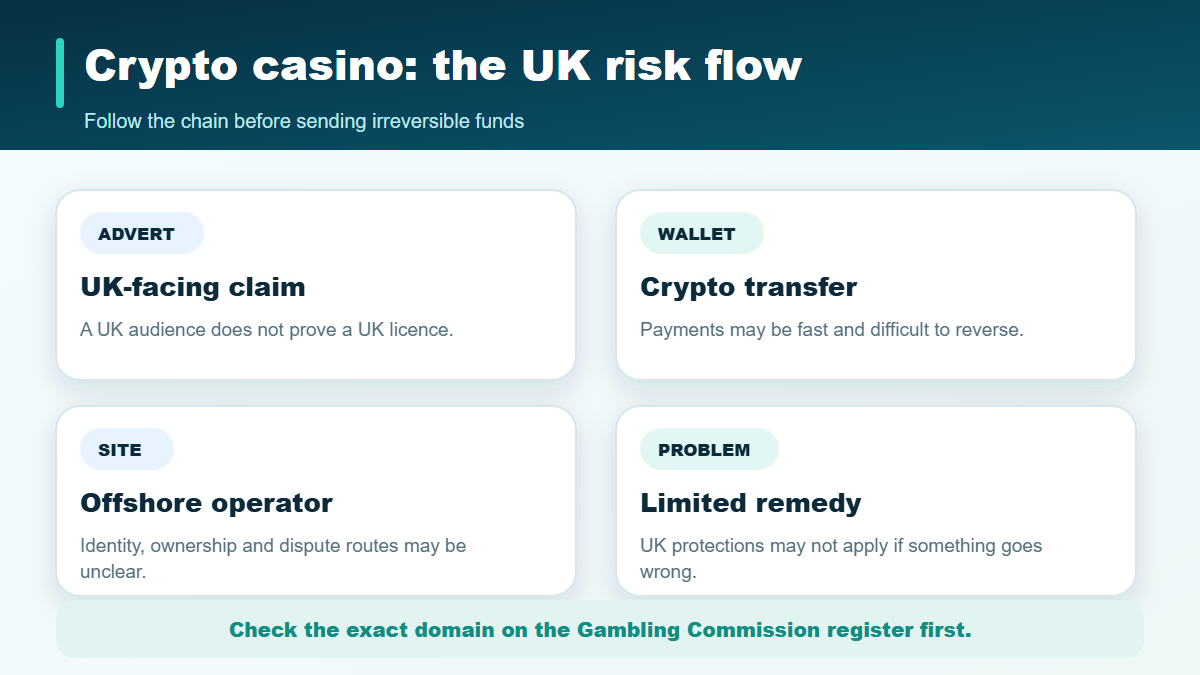
Most crypto casinos you see advertised to UK players are unlicensed because their business model doesn’t fit UK rules. They want anonymous sign-up, crypto deposits and few limits. UK licensing requires the opposite.
Offshore licences don’t cover Great Britain
Many crypto casinos say they are “licensed and regulated”. Usually this means a licence from another jurisdiction, such as Curaçao or Anjouan. Those licences do not allow an operator to serve people in Great Britain. Only a Commission licence does.
So a site can be “licensed” somewhere and still be operating illegally when it takes your bets from the UK.
“Crypto” is a common route to illegal sites
The Commission tracks how British consumers reach illegal gambling websites. In December 2024, it added crypto casino search terms to its monitoring. It found just over 1,000 unique illegal gambling websites accessed by consumers in Great Britain over its monitoring period. The number of illegal sites identified each month rose from 394 in December 2024 to 535 in July 2025. The Commission says the new crypto search terms partly explain that rise.
Summary: After the Commission started tracking crypto casino searches, the number of illegal sites it found each month rose by more than a third. Crypto is one of the main doors into the illegal market.
Source: Gambling Commission, Illegal online gambling: consumer engagement and trends
How unlicensed crypto casinos reach UK players
UK players usually find crypto casinos through:
- Search results and “best crypto casino” lists, often written by affiliates. An affiliate is a website paid a commission for sending players to a casino.
- Live streamers and social media showing big crypto wins.
- Sports sponsorship by brands whose sites are not licensed in Great Britain.
None of these is a licence check. A large following or a football shirt deal tells you nothing about whether a site can legally serve you.
What the Commission does about it
The Commission cannot easily prosecute an operator based overseas. Instead, it works to cut off access:
- Cease-and-desist letters to operators and advertisers.
- Payment referrals. After a successful test purchase on an unlicensed site, the Commission refers it to Visa, which stops it processing Visa payments. It plans to do the same with Mastercard and expects to extend this to digital wallets.
- Content removal requests to platforms, to reduce illegal sites’ visibility in Great Britain.
The Commission also notes “the emerging prevalence of cryptocurrency as a regularised form of payment across the illegal marketplace”. Crypto lets illegal sites avoid the card networks that UK enforcement relies on. That is one reason they prefer it.
Source: Gambling Commission, New tactics coming into use – Disruption of illegal online gambling
Crypto casino risks for UK players
The biggest crypto casino risk is that you lose the protections UK law gives you at a licensed site. On top of that, crypto adds its own risks: price swings, scams and tax. Here are the ones we think matter most, with what each means in practice.
No independent dispute resolution
At a UKGC-licensed casino, if a complaint isn’t resolved within eight weeks, you can take it to an approved Alternative Dispute Resolution (ADR) provider for free. ADR is an independent service that settles disputes between customers and businesses.
An unlicensed crypto casino has no UK ADR provider. If it voids your winnings or closes your account, your only option is its own support team, or a regulator in another country.
Source: Gambling Commission, ADR requirements
No GAMSTOP and weaker safer gambling tools
GAMSTOP is a free service that blocks you from every online gambling company licensed in Great Britain, for 6 months, 1 year or 5 years. Unlicensed crypto casinos are not part of it. They also don’t have to follow UK rules such as the £5 slot stake limit (£2 if you are 18–24), the ban on autoplay, or the 10x cap on bonus wagering.
If you have self-excluded, a crypto casino removes the protection you chose.
Source: GAMSTOP, Register
“No KYC” until you try to withdraw
Many crypto casinos advertise sign-up without ID checks. That can change when you ask for a large withdrawal. The site may then ask for ID, proof of address or source of funds. If you can’t provide them, or the site says you broke its terms by playing from the UK, it may refuse to pay.
At a licensed UK casino, the order is reversed. Age and identity checks must happen before you can deposit, so a surprise ID request at withdrawal shouldn’t be the reason you can’t get paid. For more on this, see our guide to why “no verification” casinos don’t exist legally in the UK.
Source: Gambling Commission, Age and ID verification
Price swings change what you win or lose
If you deposit bitcoin, your balance is often still in bitcoin. Its value in pounds can rise or fall while you play or while a withdrawal is pending. You can win a hand and still end the day with fewer pounds than you started with.
The Commission’s own guidance lists value fluctuation as a risk licensees must manage. At an unlicensed site, nobody makes the operator manage it for you.
Scams, fake sites and resold accounts
The FCA warns that scammers are active around crypto and that “if something sounds too good to be true then it probably is”. Crypto payments are hard to reverse. If you send funds to a fake casino or a cloned site, there is usually no chargeback. A chargeback is when your card provider reverses a payment.
Some players also buy “ready-verified” accounts on social media to get round location blocks. Using someone else’s account usually breaks the site’s terms, so any winnings can be refused.
Source: FCA, Crypto: the basics
No FCA or FSCS safety net
The FCA says it is “highly unlikely” you will be covered by the Financial Services Compensation Scheme (FSCS) for crypto losses, and that there is “no safety net if things go wrong”. The FSCS is the UK scheme that can compensate you if a regulated financial firm fails. Crypto held at a casino has even less protection than crypto held at an exchange.
Tax: Capital Gains Tax can apply when you spend crypto
HMRC does not treat crypto as money. It also says buying and selling crypto is not gambling. When you “dispose” of crypto, you may owe Capital Gains Tax (CGT) on any gain. GOV.UK lists selling, exchanging and “using them to pay for goods or services” as disposals.
HMRC’s guidance does not mention casino deposits specifically. But sending crypto to a casino is a way of paying for a service, so it is likely to count as a disposal if the crypto has gone up in value since you bought it. If your total gains in a tax year (6 April to 5 April) are above the CGT tax-free allowance, currently £3,000, you must report them to HMRC.
Keep a record of the date, amount and value in pounds of every crypto transfer. If you’re unsure, ask HMRC or a tax adviser.
Sources: GOV.UK, Check if you need to pay tax when you sell cryptoassets; HMRC, CRYPTO10450 – why HMRC does not consider buying and selling cryptoassets to be gambling; GOV.UK, Capital Gains Tax: allowances
Summary: At a crypto casino you lose UK protections (ADR, GAMSTOP, stake limits) and take on crypto risks (price swings, irreversible payments, no FSCS). You may also owe CGT on crypto you spend, even if you lose at the casino.
Crypto casino vs UKGC-licensed casino: side by side
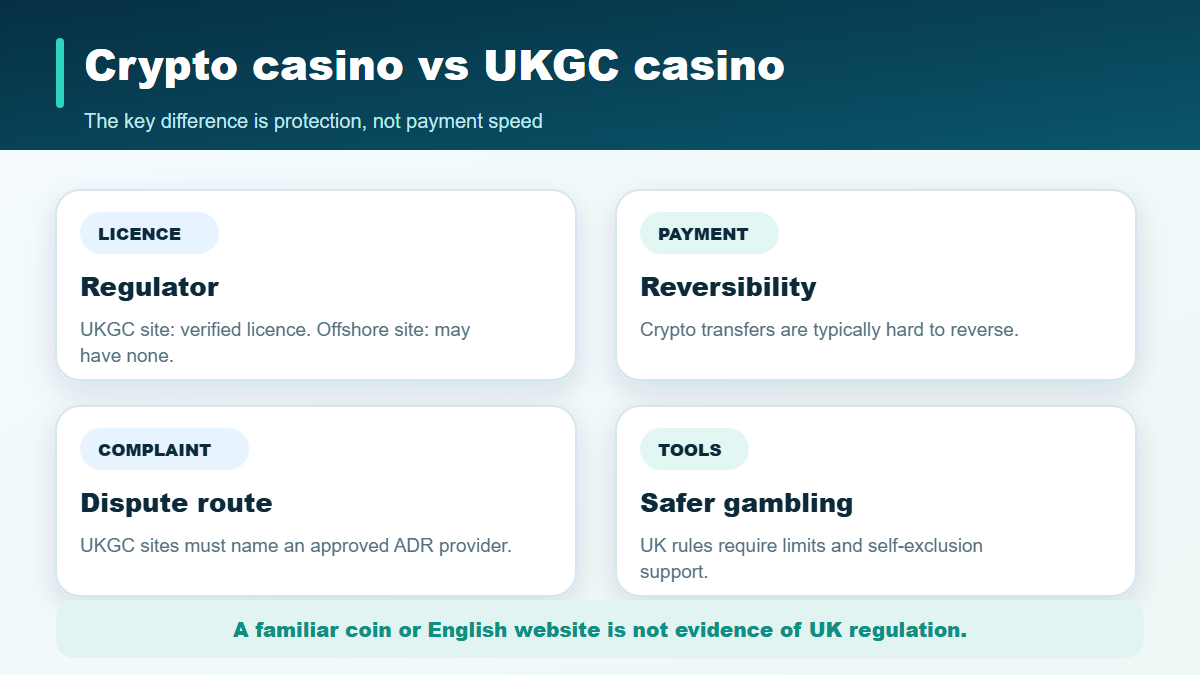
Seeing the two side by side makes the trade-off clearer. A crypto casino gives you crypto payments and fewer checks at sign-up. A licensed casino gives you rights you can enforce.
Comparison table
| Unlicensed crypto casino | UKGC-licensed casino | |
|---|---|---|
| Legal to serve GB players | No | Yes |
| Crypto deposits | Yes | None found (Nov 2026) |
| ID checks | Often at withdrawal | Before first deposit |
| Independent complaints (ADR) | No UK ADR | Free, after 8 weeks |
| GAMSTOP | Not covered | Must take part |
| Slot stake limits | None under UK rules | £5, or £2 if 18–24 |
| Bonus wagering | No UK cap | Max 10x |
| Payment reversal if scammed | Usually impossible | Card and bank protections may apply |
| CGT on deposits | Possible | Not applicable to pound payments |
Worked example: a £500 deposit in crypto
This is an illustrative example, not a forecast. It shows how two separate effects can stack up.
- You bought crypto for £200 some time ago. It is now worth £500.
- You send it all to a crypto casino. For tax, that is likely to be a disposal with a £300 gain. That gain counts towards your £3,000 CGT allowance for the year.
- You play and end the session level, with the same amount of crypto as you deposited.
- Before your withdrawal arrives, the crypto falls 20% in value. Your balance is now worth £400.
Result: you “broke even” at the tables but have £100 less in pounds. You also have a taxable event to record. At a licensed casino using pounds, steps 2 and 4 wouldn’t happen.
Summary: With crypto, the result in pounds depends on the coin’s price as well as your play. You can break even at the casino and still lose money.
Matching what you want to a legal option
People who search for crypto casinos usually want one of four things. Here is how a licensed site compares.
| What you want | Crypto casino promise | Legal option at a UKGC site |
|---|---|---|
| Fast withdrawals | “Instant crypto payouts” | Open banking or fast debit card payouts; see our fast withdrawal casino guide |
| Privacy | “No KYC” | Not available legally; ID checks happen once, at sign-up |
| To use crypto you already hold | Direct crypto deposits | Not available; selling crypto first may trigger CGT |
| Bigger bonuses or stakes | Large bonuses, no limits | Capped by UK rules designed to reduce harm |
If privacy or higher limits are the main reason, it may be worth asking why. These rules exist because the old, looser market was linked to harm.
Legal alternatives: fast payments at UK-licensed casinos
If what you really want from a crypto casino is speed, licensed UK casinos can be quick too. Several payment methods can move money in minutes or hours once your account is verified. Here are the main options and their limits.
Open banking and instant bank transfers
Open banking lets you pay directly from your bank account through your banking app, without entering card details. Many UKGC-licensed casinos support it for deposits, and some also use fast bank transfers for withdrawals. Speed depends on the operator’s approval time and your bank.
Debit cards
Visa and Mastercard debit cards are accepted at almost every licensed casino. Some card networks support fast payouts, but timing varies by operator and bank. Credit cards are banned for gambling at UK-licensed operators.
Source: Gambling Commission, Gambling on credit cards to be banned from April 2020
E-wallets
E-wallets such as PayPal are offered by some licensed casinos and can be quick to pay out. An e-wallet funded by a credit card cannot be used for gambling. Check that the casino lists the e-wallet for withdrawals as well as deposits.
How to get paid faster at a licensed site
Most delays come from the casino’s own approval stage, not the payment method. To speed things up:
- Complete ID checks when you register, not when you first win.
- Withdraw to a payment method in your own name, ideally the one you deposited with.
- Check the casino’s published “pending” time before you sign up.
Licensed casinos also cannot let you cancel a withdrawal to keep playing, which removes one common temptation.
For a full comparison of payment speeds and how to check them, read our guide to fast withdrawal casinos in the UK. For licensed sites we’ve assessed, see our best online casino UK ranking.
Red flags on “UK crypto casino” pages
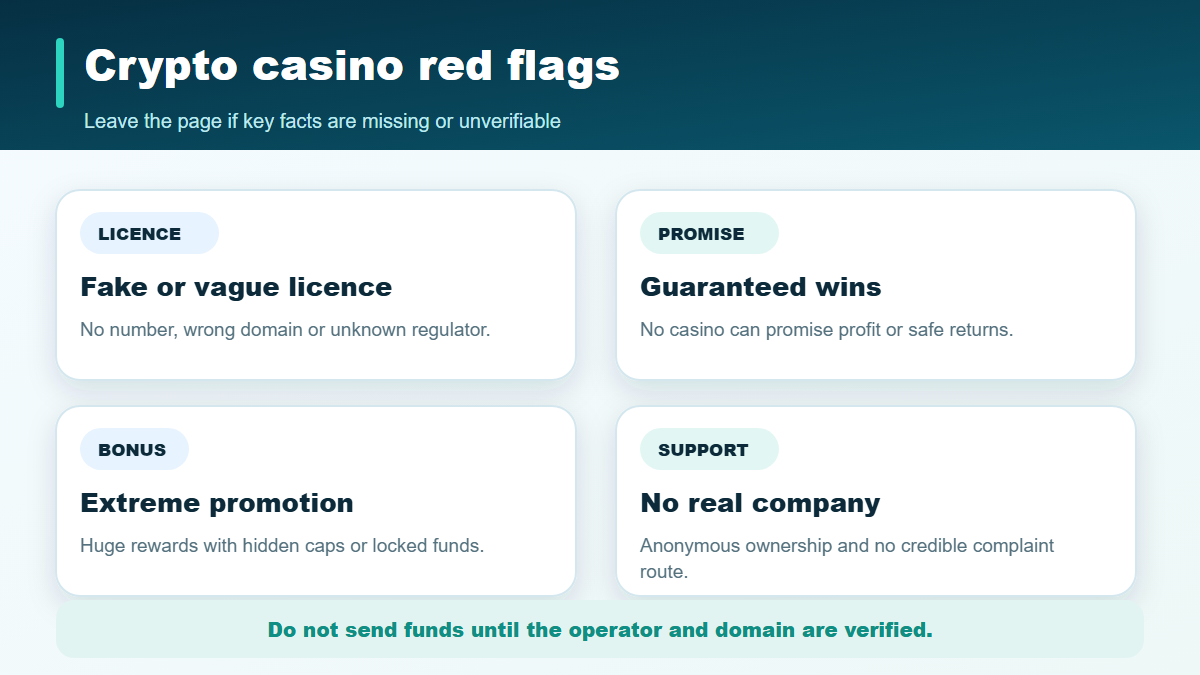
Some crypto casino pages are written to look like UK guides. These red flags suggest a site, or a page recommending it, is not on your side.
“Accepts UK players” is not a licence
A site that “accepts UK players” is describing what it does, not what it is allowed to do. Check the operator’s name and licence number on the Gambling Commission public register. If you can’t find a UK licence, it can’t legally serve you.
Source: Gambling Commission, Checks you can do to stay safe
“No KYC” and “no limits”
A UK-licensed casino must check your age and identity before you deposit and must apply stake limits on slots. A site promising “no KYC” or “no limits” is telling you it doesn’t follow UK rules.
“Not on GAMSTOP”
Every UK-licensed online casino must take part in GAMSTOP. A site that markets itself as “not on GAMSTOP” is, by definition, not licensed in Britain. The Commission has named sites targeting self-excluded people as a major concern. Our page on non-GAMSTOP casinos explains the risks in more detail.
Licence logos you can’t verify
Logos are easy to copy. A real UKGC licence number should match the company name and the website on the public register. A logo from another country’s regulator doesn’t cover British players at all.
Already used a crypto casino? What to do next
If you’ve already played at a crypto casino, you don’t need to panic, but it’s worth acting now. These steps limit further loss and keep your records straight.
Stop depositing and keep records
Don’t send more funds while you decide what to do. Save screenshots of your balance, transaction history, chat logs and the site’s terms. If you have a balance, you can try to withdraw it, but be aware the site may ask for documents or refuse.
Check your tax position
List every crypto transfer to and from the casino with the date and the value in pounds at the time. You’ll need this if you have to report gains to HMRC. A tax adviser can help if the amounts are large.
Report the site
The Commission’s “report something in confidence” service accepts reports of unlicensed gambling and money laundering concerns. Reporting won’t get your money back, but it helps the Commission’s work against illegal sites.
Source: Gambling Commission, How we tackle illegal gambling
Get support and block access
If you’re worried about how much you gamble:
- National Gambling Helpline (GamCare): 0808 8020 133, free, confidential and open 24 hours a day, 7 days a week
- GAMSTOP: blocks licensed UK sites, but not crypto casinos
- Blocking software and your bank: many UK banks let you block gambling payments from your app. Blocking software can also stop access to gambling sites, including offshore ones. Whether a bank’s gambling block also stops transfers to crypto exchanges varies by bank, so ask yours.
- Your crypto exchange: check whether it lets you block or limit transfers to gambling sites.
Sources: GambleAware, Self-exclusion; NHS, Help for problems with gambling
Checklist: before you use crypto to gamble
Use this checklist before you send any crypto to a gambling site.
| ✔ | Question | Your answer |
|---|---|---|
| ☐ | Is the operator on the Gambling Commission public register with an active licence? | |
| ☐ | Does the site say “not on GAMSTOP”, “no KYC” or “no limits”? (If yes, it isn’t UK-licensed.) | |
| ☐ | If the site refused to pay, who would I complain to? | |
| ☐ | Would a 20% fall in my coin’s price before withdrawal change my plans? | |
| ☐ | Have I recorded what I paid for this crypto, for CGT? | |
| ☐ | Am I trying to get round a GAMSTOP exclusion or bank block? | |
| ☐ | Could a licensed casino with fast bank payouts give me what I actually want? |
If you can’t answer the first question with “yes”, the safest choice is not to play there.
FAQ
Q1. Are crypto casinos legal in the UK?
Only if the operator holds a UK Gambling Commission licence. In November 2026 we found no licensed casino accepting crypto from British players. Sites taking crypto from UK players are, in practice, unlicensed.
Q2. Can I gamble with bitcoin in the UK?
Not at a licensed UK casino at the moment. UK rules allow licensed operators to accept crypto only under strict AML conditions, and we found none that does. The Commission began exploring a possible regulated route in 2026, with no timetable.
Q3. Is it illegal for me to play at a crypto casino?
The Commission’s guidance focuses on operators and advertisers: it is illegal to provide or advertise gambling to people in Great Britain without a UK licence. However, as a player you lose UK protections such as ADR and GAMSTOP, and the site may refuse to pay winnings. We are not lawyers, and this is not legal advice.
Q4. Does the UKGC allow crypto payments?
Not banned, but tightly controlled. Licensees must notify the Commission, review their AML risk assessment and manage risks such as price swings to the same standard as other payment methods.
Q5. Do I pay tax when I deposit crypto at a casino?
You might. HMRC treats using crypto to pay for goods or services as a disposal for Capital Gains Tax. If your crypto has risen in value since you bought it, the gain may count towards your annual £3,000 allowance. Check with HMRC or a tax adviser.
Q6. Are crypto casinos covered by GAMSTOP?
No. GAMSTOP covers online gambling companies licensed in Great Britain. Unlicensed crypto casinos are outside it.
Q7. When will UK casinos accept crypto?
There is no date. The Commission has set no deadline for its review, and the FCA’s crypto regime isn’t expected to start until 25 October 2027.
Q8. What’s the fastest legal way to get casino winnings in the UK?
At UKGC-licensed casinos, open banking, fast debit card payouts and some e-wallets can be quick once your account is verified. Speed depends mostly on the casino’s approval time. See our fast withdrawal casino guide.
Summary
Crypto casinos in the UK are, in practice, unlicensed. UK law requires a Gambling Commission licence for any site serving British players, and we found no licensed casino accepting crypto in November 2026.
Key points:
- Licence first: an offshore licence (for example, Curaçao or Anjouan) does not allow a site to serve Great Britain.
- Crypto isn’t banned, but it is controlled: licensees must meet strict AML conditions, which has kept crypto out of the licensed market so far.
- Things may change, slowly: the Commission began exploring a regulated route in 2026, and the FCA’s crypto regime starts in October 2027.
- The risks are real: no ADR, no GAMSTOP, surprise ID checks, price swings, irreversible payments and possible Capital Gains Tax.
- Legal speed exists: UKGC-licensed casinos with open banking or fast debit card payouts can pay quickly once you’re verified.
Ready for fast payouts without the crypto risks? A UK-licensed casino can pay you quickly in pounds, with no price swings, no surprise CGT on deposits and a free dispute service if something goes wrong:
- Fastest published promise: MrQ – “processed within 60 seconds or get £10”, with 100 no-wagering spins for a £10 first deposit.
- Under 30 minutes for most withdrawals: Kwiff – plus 200 no-wagering spins when you stake £20 (£250 win cap).
- Instant bank payouts: Sky Vegas – Pay by Bank arrives immediately, and you can start with 50 no-deposit spins.
18+ | Please gamble responsibly – set a deposit limit.
Before you send crypto anywhere: Spend two minutes checking the operator on the official register. If it isn’t there, you’ll have no UK protection if something goes wrong.
- Check the licence on the Gambling Commission public register.
- Compare legal fast-payment options in our fast withdrawal casino guide.
- See UKGC-licensed casinos we’ve assessed in our BEST10 best online casino UK ranking.
If you’re worried about your gambling, or someone else’s, call the National Gambling Helpline on 0808 8020 133.
Sources
- Gambling Commission: How we tackle illegal gambling (last updated 18 September 2025)
- Gambling Commission: Blockchain technology and crypto-assets (last updated 28 March 2023)
- Gambling Commission: BGC AGM 2026 – Tim Miller speech (26 February 2026)
- Gambling Commission: Ethical Gambling Forum – Tim Miller speech (28 April 2026)
- Gambling Commission: Illegal online gambling: consumer engagement and trends (published 25 September 2025, updated 31 October)
- Gambling Commission: New tactics coming into use – Disruption of illegal online gambling (published 21 October 2025, updated 16 January 2026)
- Gambling Commission: ADR requirements
- Gambling Commission: Age and ID verification
- Gambling Commission: Checks you can do to stay safe
- Gambling Commission: Gambling on credit cards to be banned from April 2020
- Gambling Commission: Public register
- FCA: Crypto: the basics
- FCA: New regime for cryptoasset regulation
- NHS: Help for problems with gambling
- GOV.UK: Check if you need to pay tax when you sell cryptoassets
- GOV.UK: Capital Gains Tax: allowances
- HMRC: CRYPTO10450 – why HMRC does not consider buying and selling cryptoassets to be gambling
- GAMSTOP: Register
- GambleAware: Self-exclusion
Operator pages used for the picks and CTA (official pages, checked 12 November 2026)