Written by John Wellington | Last checked:
18+ only. Gambling can be addictive. If gambling is causing you problems, call the National Gambling Helpline free on 0808 8020 133 (24/7).
Disclosure: This page does not contain affiliate links. This article was drafted with the help of AI and checked by our editor against official sources.
You may have searched for non GAMSTOP casinos because you signed up to GAMSTOP and now want to play again. Or you may have seen an advert for a casino “not on GAMSTOP” and wondered whether it is legal. Either way, you are not alone, and this page will not judge you.
Here is the short version. A non GAMSTOP casino is a site that is not licensed in Great Britain. That means none of the UK’s protections apply if it keeps your money, loses your data or lets you gamble far more than you planned.
What you’ll learn
- what non GAMSTOP casinos are, and whether they are legal
- what the Gambling Commission is doing about them
- the real risks to your money and your recovery
- whether GAMSTOP can be cancelled early
- what you can do right now if the urge to gamble is strong
We do not list or link to any non-GAMSTOP sites. Instead, we give you the facts and the free support that is available.
Need to talk now? Call the National Gambling Helpline on 0808 8020 133. It is free, confidential and open 24 hours a day. In Wales, you can also call 0808 2819 265. You can use live chat through GamCare instead if you’d rather not speak.
Source: Gambling Commission, Commission ramps up action against illegal gambling profits and assets
Non GAMSTOP casinos: the short answer
Non GAMSTOP casinos are online casinos that do not hold a licence from the Great Britain Gambling Commission. They are not on GAMSTOP because every licensed online operator must be. So “not on GAMSTOP” is another way of saying “not licensed to serve you in Great Britain”.
What a “non-GAMSTOP casino” actually is
GAMSTOP is a free self-exclusion service. Self-exclusion means you ask to be blocked from gambling for a set time. One GAMSTOP registration blocks you from all gambling companies licensed in Great Britain at once.
A “non-GAMSTOP casino” is a website that does not check GAMSTOP. It is usually run from abroad and may hold a licence from another country. You will also see these sites called “casinos not on GAMSTOP”, “non UK casinos” or “offshore casinos”.
Source: GAMSTOP, How it works
Why every UK-licensed online casino is on GAMSTOP
Joining GAMSTOP has been a licence condition for online gambling operators since 31 March 2020. The rule sits in the Gambling Commission’s Licence Conditions and Codes of Practice (LCCP), social responsibility code 3.5.5. The Commission says it will not license a gambling website unless it meets conditions such as GAMSTOP registration and safer gambling tools.
This means there is no such thing as a UKGC-licensed online casino that is “not on GAMSTOP”. If a site says it is both, something is wrong.
Sources: Gambling Commission, LCCP 3.5.5 Remote multi-operator self-exclusion; Gambling Commission, Two operators’ licences suspended for failure to participate in GAMSTOP; Gambling Commission, Raising Standards for consumers – Consumer guidance on unlicensed websites
Why this page doesn’t list any sites
Most pages that rank for “non gamstop casinos” are lists of offshore sites with “Play now” buttons. Those pages often earn money when readers sign up through their links.
We take a different view. Sites that are not licensed in Great Britain are acting illegally when they offer gambling to people here (see the next section). They also remove the protections you would otherwise have. So we will never list or link to them, and we earn nothing from any casino.
Who this page is for
- If you have self-excluded and are tempted to play: skip to what to do now. The urge often passes, and help is free.
- If you saw an advert and want to know if it’s safe: read the risks and how to spot an illegal site.
- If you have not self-excluded and simply want somewhere to play: read our guide on how to choose a safe, UKGC-licensed online casino instead.
- If you’re worried about someone else: see the support for family and friends.
Are non GAMSTOP casinos legal in the UK?
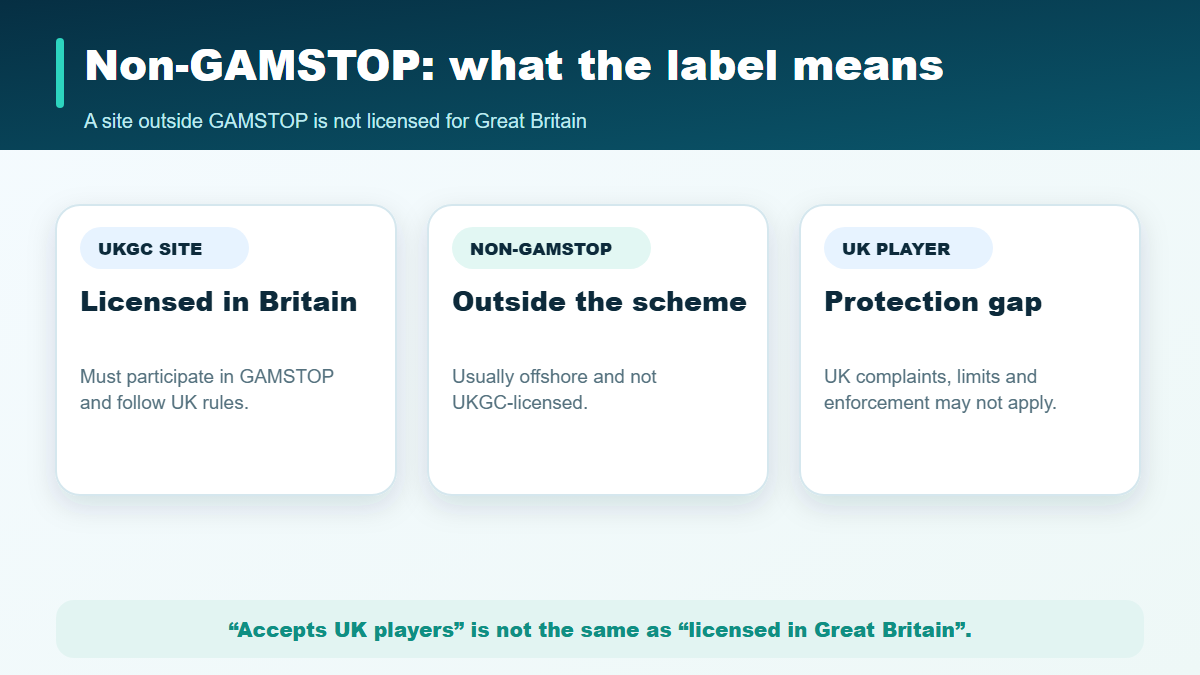
No. A non GAMSTOP casino that offers gambling to people in Great Britain is breaking British law, because it has no Gambling Commission licence. The offence is committed by the operator. We have not found a primary source saying that a player commits an offence just by using one. But a player loses all UK protections.
For the operator: offering gambling in Great Britain without a licence is a crime
The Gambling Commission states: “It is illegal to provide gambling facilities to consumers in Great Britain” without an operating licence. This applies “regardless of where in the world the gambling is provided from”.
The offence is in section 33 of the Gambling Act 2005. A person found guilty can face up to 51 weeks in prison in England and Wales (six months in Scotland), a fine, or both. It is also a criminal offence to advertise unlawful gambling to people in Great Britain.
Sources: Gambling Commission, How we tackle illegal gambling; legislation.gov.uk, Gambling Act 2005, section 33
For the player: what the law does and doesn’t say
Section 33 targets the person who provides facilities for gambling. It does not mention players. The Commission’s guidance on illegal gambling also describes offences by operators and advertisers, not by customers.
We are not lawyers, and this is not legal advice. What we can say clearly is this: using an unlicensed site means stepping outside the system that protects you. The Commission says people who use illegal sites “expose themselves to risks and are not afforded the protections required in the regulated sector”.
Source: Gambling Commission, National Strategic Assessment 2020 – Unlicensed gambling
“Licensed in Curaçao” is not a UK licence
Many non GAMSTOP casinos show a licence from another place, such as Curaçao, Anjouan or Kahnawake. These licences do not allow a company to offer gambling to people in Great Britain. The Commission says a site licensed elsewhere is still not licensed by the British Gambling Commission.
A foreign licence also does not give you access to UK complaint routes. If something goes wrong, you would have to deal with a regulator abroad, under its rules, if it takes complaints at all.
Source: Gambling Commission, Raising Standards for consumers – Consumer guidance on unlicensed websites
“Offshore”, “non-UK” and “black market” mean the same thing here
Adverts prefer soft words like “offshore”, “international” or “independent”. The Gambling Commission calls them “illegal” or “unlicensed” gambling websites when they target people in Great Britain. People in the industry also call this the “black market”.
Note that “independent” can also describe small casinos that are UKGC-licensed and on GAMSTOP. If you want to know the difference, see our guide to independent casinos in the UK.
Summary: A non GAMSTOP casino offering gambling to people in Great Britain is acting illegally because it has no UK licence. The law targets the operator. But if you use one, you have none of the protections a UK licence gives you.
What the Gambling Commission is doing about illegal casino sites (2024–2026)
The Commission has stepped up action against illegal gambling sites since 2024. It cannot simply switch them off, because most are run from abroad. Instead it tries to make them harder to find, harder to pay and less profitable. Here is what it has published.
Removing sites from Google and Bing search results
From April 2024 to mid-2025, the Commission referred 447,778 URLs to Google and Bing and 287,961 were removed. It says it has referral routes with Google, Bing and Yahoo, which together cover about 97% of searches in Great Britain. These allow “automatic delisting of illegal content”.
The scale then grew sharply. In 2026/27 so far, the Commission says it has referred 7.8 million URLs to search engines and 3 million have been removed from search results.
Sources: Gambling Commission, Illegal online gambling: Disruption of illegal online gambling; Gambling Commission, Confronting the threat: how we’re tackling illegal gambling in Great Britain
Cutting off payments
The Commission makes “test purchases” on illegal sites to collect the banking details they use. It then refers these to Visa and Mastercard. It says it is also working with PayPal, Google Pay and Apple Pay. It calls reporting payment data to Visa “a critical element of our enforcement strategy”, though it describes this work as still at an early stage.
This is one reason illegal sites push crypto and other payment methods that are harder to trace.
Source: Gambling Commission, Confronting the threat
Targeting adverts on social media
Illegal sites often advertise on social media. The Commission says it is expanding its work with Meta, TikTok, X and YouTube to deal with illegal gambling adverts. It also notes that illegal operators target vulnerable people through search terms such as “NotonGamstop”.
Source: Gambling Commission, Confronting the threat
November 2026: going after the money
On 9 November 2026, the Commission said it is moving beyond taking down websites to target the money and assets behind illegal operators. In 2026/27 so far, it reports:
| Action | Figure |
|---|---|
| Cease and desist notices sent to illegal operators | More than 1,000 |
| URLs referred to search engines | 7.8 million |
| URLs removed from search results | 3 million |
| Websites referred for disruption action | 2,200 |
| Suspected criminal funds referred for possible freezing (since January 2026) | More than £40 million |
The Commission’s executive director of operations, Sue Young, said: “If you run an illegal gambling operation, we are coming after you, your business and your money.” The announcement marked the first Illegal Gambling Awareness Week (9–13 November 2026).
Source: Gambling Commission, Commission ramps up action against illegal gambling profits and assets
How many people use illegal sites
On 5 November 2026, the Commission published early survey estimates. Among people who had gambled online in the past 12 months, 2.5% had used an illegal site in the past four weeks. Use was higher among men, and among younger adults, especially those aged 18 to 24.
The Commission also said research suggests people who use illegal operators “are more likely to experience harm”.
Source: Gambling Commission, New survey data to help tackle illegal gambling and protect consumers
Why the same sites keep coming back
The Commission is open about the limits. It says “while sites often reappear”, search removal is still worth doing. Sites that are blocked in Great Britain can also still be reached with a VPN.
So the fact that a site is easy to find on Google, or appears in an advert, tells you nothing about whether it is legal or safe.
Summary: The Commission is removing millions of illegal casino links from search results and working with card networks, payment apps and social media. Since November 2026 it is also going after operators’ money. Sites still reappear under new addresses, so being easy to find is not a sign of safety.
The real risks of casinos not on GAMSTOP
The biggest risk is simple: if anything goes wrong, nobody in the UK can make the site put it right. The Commission lists “unfair gaming practices, financial loss, and a lack of recourse if things go wrong”, plus “risks of identity theft and fraud”.
No independent dispute service if things go wrong
At a UKGC-licensed casino, if a complaint isn’t solved within eight weeks, you can take it to an approved Alternative Dispute Resolution (ADR) provider. ADR means an independent body that settles disputes for free. Non GAMSTOP casinos are not part of this system. The Gambling Commission cannot act for you against them either.
Source: Gambling Commission, ADR requirements
Winnings that are withheld or changed
The Commission says “some illegal gambling sites are blocking payouts or setting withdrawal limits so high they’re unattainable”.
Its 2025 research with people who use illegal sites found similar stories. One self-excluded woman described sites that disconnected her mid-game, changed her winnings and made withdrawals difficult. She said: “It got to the point where I was taking screenshots of my winnings to prove they were right.”
Sources: Gambling Commission, Confronting the threat; Gambling Commission, Illegal online gambling – Phase 1: Self-excluders
Your ID documents and bank details
Many illegal sites let you sign up with just an email address. Later, when you try to withdraw, they may ask for passport scans, utility bills or bank statements. You are then sending sensitive documents to a company you cannot trace, in a country where UK data protection may be hard to enforce. The Commission warns of “serious data protection concerns for players, with risks of identity theft and fraud”.
If you’re attracted by “no ID” sites, our guide to why UK casinos check your ID explains what licensed sites must do and why.
Credit cards and crypto: easier ways to lose more
Since 14 April 2020, UK-licensed operators cannot accept credit cards, including e-wallets funded by a credit card. Many illegal sites still do. Gambling on credit means you can lose money you don’t have, and pay interest on it.
The Commission’s research found that quick access to money is part of the appeal for self-excluders, especially when bank gambling blocks are switched on. Credit cards and crypto were used to get round those blocks. Crypto payments are also very hard to reverse.
For the full picture, see our explainers on credit card gambling in the UK and crypto casinos and UK law.
Sources: Gambling Commission, Gambling on credit cards to be banned from April 2020; Gambling Commission, Illegal online gambling – Phase 1: Self-excluders
No stake limits and no game-design rules
At UKGC-licensed sites, online slot stakes are capped at £5 per spin, or £2 if you are 18 to 24. Slots must also have no autoplay, no turbo spins and a minimum spin time of 2.5 seconds. Bonus wagering is capped at 10x.
None of these rules apply on illegal sites. That’s often what the adverts sell as “no limits”. In practice, it means you can lose much more, much faster.
Sources: GOV.UK, New £2 maximum stake for under 25s playing online slots; Gambling Commission, Gambling promotions to be safer and simpler
Marketing that targets people who have self-excluded
The Commission’s research found that self-excluders mostly find illegal sites by searching “not on GAMSTOP”. After that, some received marketing emails and even unsolicited phone calls. Looking back, participants described the sites as “predatory”. One said: “They are deliberately targeting people who have self-excluded.”
If this is happening to you, it is not a sign of weak willpower. These sites are designed to find people at exactly this point.
Source: Gambling Commission, Illegal online gambling – Phase 1: Self-excluders
UKGC-licensed vs non-GAMSTOP: side by side
| Protection | UKGC-licensed casino | Non GAMSTOP casino |
|---|---|---|
| Checks GAMSTOP | Yes, licence condition | No |
| Age and ID checks before you deposit | Yes | Often skipped at sign-up |
| Free independent dispute service (ADR) | Yes, after 8 weeks | No UK route |
| Gambling Commission can take action | Yes | Only enforcement against the site, not your money |
| Credit cards | Banned | Often accepted |
| Slot stake limit | £5 (£2 if aged 18–24) | None |
| Bonus wagering cap | 10x | None |
| Reverse withdrawals | Banned | No UK rule applies |
Summary: At a non GAMSTOP casino, your money, your data and your limits all depend on the goodwill of a company you can’t hold to account in the UK. For someone who has self-excluded, the lack of limits is the biggest risk of all.
How to spot a non GAMSTOP or black-market casino
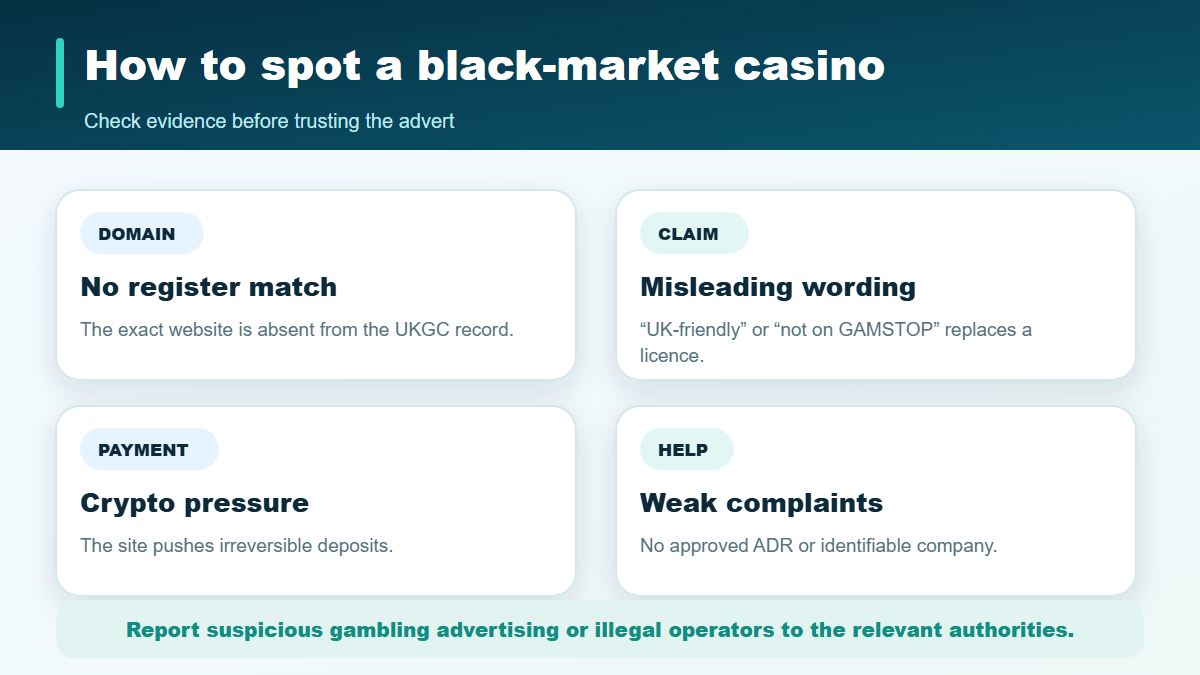
You can usually spot an illegal site in under a minute. Look for the signs below. If you see even one, the safest step is to close the page.
No UKGC account number, or one that doesn’t match the register
Licensed sites normally show the Gambling Commission logo and their account number, and they must link to the Commission’s public register. Search for the number or company name on the public register. Check that the licence is active and that the website address is listed.
A logo alone proves nothing, because it can be copied.
Source: Gambling Commission, Checks you can do to stay safe
“Not on GAMSTOP” or “no verification” in the advert
A licensed operator cannot advertise that it ignores GAMSTOP, because it must take part. So any site sold as “not on GAMSTOP”, “GAMSTOP-free” or “for self-excluded players” is, by definition, not licensed to serve you.
It accepts credit cards, or only crypto
UKGC-licensed casinos cannot accept credit cards. A site that offers credit card deposits to UK players is very likely not licensed in Great Britain. Crypto-only cashiers are another strong sign.
You can sign up without age or ID checks
UK-licensed operators must verify your age before you can deposit or play, even on free demo games. In its research, the Commission treated “signing up without age or identity verification” as a clear sign that a site was not licensed.
Sources: Gambling Commission, Age and ID verification; Gambling Commission, Illegal online gambling – Phase 2: Indicators
An offshore licence, a foreign currency or a foreign language
A site that shows only a Curaçao, Anjouan or other foreign licence is not licensed here. A site that defaults to euros, US dollars or another language may also be based outside Great Britain.
The page promoting it is on an unrelated or old website
Many “non gamstop casinos” lists sit on websites that used to be something else, such as a former politician’s site, a shop or a local charity. Some use the old domain of a public body. For example, the domain of the Phone-paid Services Authority (PSA), which stopped operating in February 2025 when its role passed to Ofcom, now hosts a non-GAMSTOP casino guide written under a pen name. That page is not guidance from Ofcom or the Gambling Commission.
A familiar-looking address is not a sign that the advice is official. Check whether the page is on gamblingcommission.gov.uk, gov.uk, gamstop.co.uk or an NHS site.
Summary: No UKGC number on the register, “not on GAMSTOP” in the advert, credit cards accepted, no ID checks, or a foreign licence: any one of these means the site is not licensed to serve you in Great Britain.
Can I cancel GAMSTOP or get off it early?
No. Once you have registered, GAMSTOP cannot be cancelled or shortened during the exclusion period you chose. When the period ends, the block stays in place until you contact GAMSTOP to remove it.
You can’t cancel during your chosen period
GAMSTOP says: “Once you’ve registered, you cannot cancel your registration during the exclusion period.” You can choose 6 months, 1 year or 5 years. There is no early-release form, and contacting UK casinos directly won’t change it, because they must check GAMSTOP.
This is by design. The service works because the decision you made at a calmer moment holds when the urge is strongest.
Sources: GAMSTOP, How it works; NHS, Help for problems with gambling
What happens when your exclusion period ends
The block does not lift automatically. GAMSTOP says your exclusion “stays in place after the end of the period you’ve chosen unless you choose to remove it by contacting us”.
If you do ask for it to be removed, it’s worth giving yourself time to think it through first. You could talk it over with someone at the National Gambling Helpline.
Extending or renewing your exclusion
You can extend your registration through your GAMSTOP account. You can also choose to renew automatically, so the block continues without you having to act.
Sources: GAMSTOP, Gamstop Online; GAMSTOP, How it works
If you’re looking for a way around it
Searching for “how to get off GAMSTOP” is very common, and many people who search for it are in a hard moment. The pages that answer that search with a list of offshore casinos are not on your side. They make money when you sign up.
A more useful question may be: “What would help me get through the next hour?” The next section answers that.
If you’ve self-excluded and want to gamble: what to do now
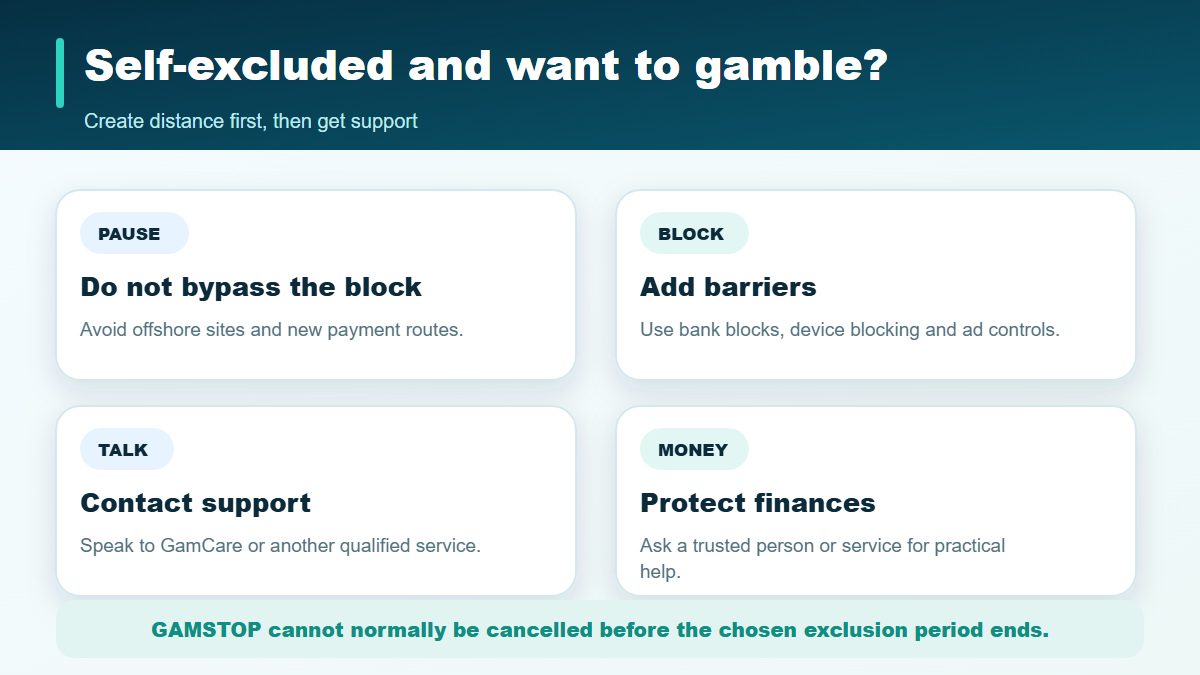
Urges to gamble usually come in waves and pass. The steps below are free and can be started today. You don’t need to do all of them. Pick one.
Talk to someone today: the National Gambling Helpline
The National Gambling Helpline is run by GamCare. It offers free information, support and counselling.
- Phone: 0808 8020 133 (free, 24/7)
- Wales: 0808 2819 265
- Live chat: through the GamCare website
You don’t need to be “bad enough” to call. Many people call just to get through an urge.
Sources: NHS, Help for problems with gambling; Gambling Commission, Commission ramps up action against illegal gambling profits and assets
Get free NHS treatment
If you live in England, you can refer yourself to an NHS gambling clinic, or ask your GP about services in your area. NHS clinics include psychiatrists and psychologists, and they can also support family members. There are regional services, such as the NHS Northern Gambling Service and the NHS Southern Gambling Service, as well as the National Gambling Clinic in London.
Source: NHS, Help for problems with gambling
Block gambling sites on your devices
GAMSTOP only blocks UK-licensed operators. Blocking software can also block illegal sites on your phone and computer.
| Tool | Cost | What it does |
|---|---|---|
| BetBlocker | Free for everyone (run by a charity) | Blocks gambling sites on Windows, Mac, Android, iOS and more. Once a block starts, it cannot be lifted before the end of the period you chose. |
| Gamban | Paid subscription with a 7-day free trial (£4.99 a month or £29.99 a year as of March 2026). Free for Wales residents. Check Gamban’s own website for current UK pricing, as free-access schemes have changed during 2026. | Blocks gambling sites and apps across your devices. |
GAMSTOP’s own support page lists both tools. Setting a block that you can’t undo works the same way as GAMSTOP: it protects the decision you’ve already made.
Sources: BetBlocker, BetBlocker; Gamban, Why is TalkBanStop ending?; GAMSTOP, Tools and support
Turn on your bank’s gambling block
Most UK banks offer a free gambling block. It stops card payments to gambling sites, online or in person. You can usually switch it on in your banking app under “card controls”, by phone or in a branch. You need to set it on each card.
GamCare notes that blocks don’t affect your credit score. It also notes a gap: bank transfers (Faster Payments) to gambling operators are not always caught. If you use a credit card, consider asking your provider to block gambling, or leaving the card at home.
Source: GamCare, Everything you need to know about bank gambling blocks
If you’ve already used a non-GAMSTOP site
If you’ve already deposited, try not to be hard on yourself. Here is a calm order of steps:
- Stop depositing. Don’t try to win back what you’ve lost. Chasing losses is how small losses become large ones.
- Request a withdrawal of any balance, and keep screenshots of your balance and messages.
- Close the account and unsubscribe from emails and texts.
- Install blocking software and switch on your bank’s gambling block.
- Get free debt advice if you’ve borrowed or used a credit card. The NHS lists Citizens Advice among the organisations that can help.
- Call the National Gambling Helpline on 0808 8020 133 to talk it through.
Be aware that UK bodies cannot force an illegal site to pay you.
Support for family and friends
If someone you care about is using non GAMSTOP casinos, support is available for you too. The NHS lists GamFam, a lived-experience support network for people affected by someone else’s gambling, and GamAnon, which holds meetings. GAMSTOP also has a page for supporting a loved one.
Sources: NHS, Help for problems with gambling; GAMSTOP, Support someone
If you feel unsafe
If gambling has left you feeling hopeless or thinking about harming yourself, please reach out now. You can call Samaritans free on 116 123 or text SHOUT to 85258. If your life is at risk, call 999.
Source: GAMSTOP, Tools and support
Summary: You can’t cancel GAMSTOP early, but you don’t have to fight the urge alone. Call 0808 8020 133, add free blocking software, switch on your bank’s gambling block, and refer yourself to the NHS if you want treatment.
How to report an illegal gambling site
If you’ve seen an advert for a non GAMSTOP casino, or used one, you can report it to the Gambling Commission. Reports feed into the disruption work described above.
Use the Commission’s “Tell us something in confidence” service
The Commission’s confidential reporting service is called Tell us something in confidence. It covers unlicensed gambling and other suspicious activity. You can report anonymously and upload screenshots or documents.
Sources: Gambling Commission, How we tackle illegal gambling; Gambling Commission, Tell us something in confidence
What to include in your report
The more specific you are, the more useful the report is. Try to include:
- the website address (and any other addresses it redirects to)
- where you saw it, such as a search result, a social media advert, an email or a text
- screenshots of “not on GAMSTOP” claims or credit card payment options
- the date you saw it
You don’t need to have used the site to report it.
What the Commission can and can’t do for you
The confidential service is for intelligence, not complaints. The Commission says it does not resolve complaints about gambling transactions, and it cannot recover money from an illegal site. It uses reports to target sites, payment routes and adverts.
If your issue is with a UKGC-licensed operator, use that operator’s complaints process and then its ADR provider after eight weeks.
Checklist: before you click a “not on GAMSTOP” advert
Use this checklist if you’re looking at a site and aren’t sure.
| ✔ | Question | If the answer is “no” |
|---|---|---|
| ☐ | Can I find its licence number on the Gambling Commission’s public register, with this website listed? | It’s not licensed in Great Britain. Close the page. |
| ☐ | Does it check GAMSTOP? | It’s not licensed in Great Britain. |
| ☐ | Does it refuse credit cards? | If it accepts them, it’s very likely illegal here. |
| ☐ | Does it ask for age and ID checks before I can deposit? | If not, that’s a strong warning sign. |
| ☐ | Would a UK dispute service (ADR) be named in its terms? | You’d have no free, independent route to complain. |
| ☐ | Am I looking at this because I’ve self-excluded? | If yes, see the five steps below. |
Five steps when the urge hits
- Close the page.
- Call 0808 8020 133 or open GamCare’s live chat.
- Install BetBlocker or another blocker so the site won’t load.
- Switch on your bank’s gambling block.
- Tell one person you trust what’s going on.
FAQ
Q1. What are non GAMSTOP casinos?
They are online casinos that are not licensed by the Gambling Commission and don’t check GAMSTOP. They are usually based abroad. Because every UK-licensed online operator must join GAMSTOP, a casino “not on GAMSTOP” is not licensed to serve players in Great Britain.
Q2. Are non GAMSTOP casinos legal in the UK?
No, not for the operator. Offering gambling to people in Great Britain without a Commission licence is a criminal offence under section 33 of the Gambling Act 2005. We have not found a primary source saying a player commits an offence by using one. But you lose all UK protections.
Q3. Can I cancel GAMSTOP early?
No. GAMSTOP says you cannot cancel your registration during the exclusion period you chose. You can extend it, but not shorten it.
Q4. How do I get off GAMSTOP when my exclusion ends?
You have to contact GAMSTOP. The block doesn’t lift on its own; it stays in place after the end date until you ask for it to be removed. Before you do, it may help to talk it through with the National Gambling Helpline on 0808 8020 133.
Q5. Do non UK casinos have to pay my winnings?
Not under any rule the UK can enforce. The Gambling Commission says some illegal sites block payouts or set withdrawal limits so high they can’t be reached. There is no UK dispute service to help you.
Q6. Will GAMSTOP block offshore casinos?
No. GAMSTOP only blocks companies licensed in Great Britain. To block illegal sites as well, use blocking software such as BetBlocker or Gamban, and turn on your bank’s gambling block.
Q7. Why do I keep seeing adverts for casinos not on GAMSTOP?
Illegal operators advertise through search results, social media and emails, and research shows they target people who have self-excluded. The Commission is working with search engines and social media platforms to remove these adverts. You can report any you see.
Q8. How do I report a non GAMSTOP casino?
Use the Gambling Commission’s “Tell us something in confidence” service at tellus.gamblingcommission.gov.uk. You can report anonymously and attach screenshots.
Q9. Is there a safe way to play if I haven’t self-excluded?
If you have not self-excluded and gambling isn’t causing you problems, play only at casinos licensed by the Gambling Commission. Set a deposit limit before your first deposit. Our guide to choosing a UKGC-licensed online casino explains the checks.
Summary
Non GAMSTOP casinos are not a loophole. They are sites with no licence to serve people in Great Britain, and offering gambling here without a licence is a crime for the operator.
Key points:
- Every UK-licensed online casino is on GAMSTOP. “Not on GAMSTOP” means “not licensed in Great Britain”.
- The law targets the operator, but players lose UK protections: no ADR, no stake limits, no credit card ban, and no one to make the site pay.
- The Commission is acting: 7.8 million URLs referred to search engines in 2026/27 so far, and more than £40 million in suspected criminal funds referred since January 2026.
- GAMSTOP can’t be cancelled early, and the block stays after the end date until you ask to remove it.
- Help is free: National Gambling Helpline 0808 8020 133, NHS gambling clinics, BetBlocker and bank gambling blocks.
If you’ve self-excluded and are tempted to play, the most useful thing you can do right now is talk to someone. It takes a few minutes, it’s free, and nobody will judge you.
- Call the National Gambling Helpline on 0808 8020 133 (24/7), or use GamCare’s live chat.
- Install a gambling blocker such as BetBlocker and switch on your bank’s gambling block today.
- Refer yourself to an NHS gambling clinic through the NHS gambling support page.
If you saw an advert for a non GAMSTOP casino, report it through the Commission’s Tell us something in confidence service.
If you haven’t self-excluded and want to play safely, read our guide on how to choose a UKGC-licensed online casino and check any site on the Gambling Commission public register first.
Sources
- Gambling Commission: Commission ramps up action against illegal gambling profits and assets (9 November 2026)
- Gambling Commission: New survey data to help tackle illegal gambling and protect consumers (5 November 2026)
- Gambling Commission: Illegal online gambling: Disruption of illegal online gambling (published 21 October 2025)
- Gambling Commission: Confronting the threat: how we’re tackling illegal gambling in Great Britain (21 October 2025)
- Gambling Commission: How we tackle illegal gambling
- Gambling Commission: Illegal online gambling – Phase 1: Self-excluders (September 2025)
- Gambling Commission: Illegal online gambling – Phase 2: Indicators
- Gambling Commission: National Strategic Assessment 2020 – Unlicensed gambling
- Gambling Commission: Raising Standards for consumers – Consumer guidance on unlicensed websites
- Gambling Commission: LCCP 3.5.5 Remote multi-operator self-exclusion
- Gambling Commission: Two operators’ licences suspended for failure to participate in GAMSTOP (3 April 2020)
- Gambling Commission: Checks you can do to stay safe
- Gambling Commission: Age and ID verification
- Gambling Commission: Gambling on credit cards to be banned from April 2020
- Gambling Commission: Gambling promotions to be safer and simpler
- Gambling Commission: ADR requirements
- Gambling Commission: Public register
- Gambling Commission: Tell us something in confidence
- legislation.gov.uk: Gambling Act 2005, section 33
- GOV.UK: New £2 maximum stake for under 25s playing online slots
- GAMSTOP: How it works
- GAMSTOP: Tools and support
- GAMSTOP: Support someone
- NHS: Help for problems with gambling
- GamCare: Everything you need to know about bank gambling blocks
- GamCare: Talk to us now
- BetBlocker: BetBlocker
- Gamban: Why is TalkBanStop ending? (31 March 2026)